|
|
|
|
|
|
|
|
|
|
|
|
|
|
|
|

Thoughts about the markets, automated trading algorithms, artificial intelligence, and lots of other stuff

Here are some of the posts that caught my eye recently. Hope you find something interesting.
To give you a break from your year-end planning, here's something that requires no brain cells.
SNL via YouTube
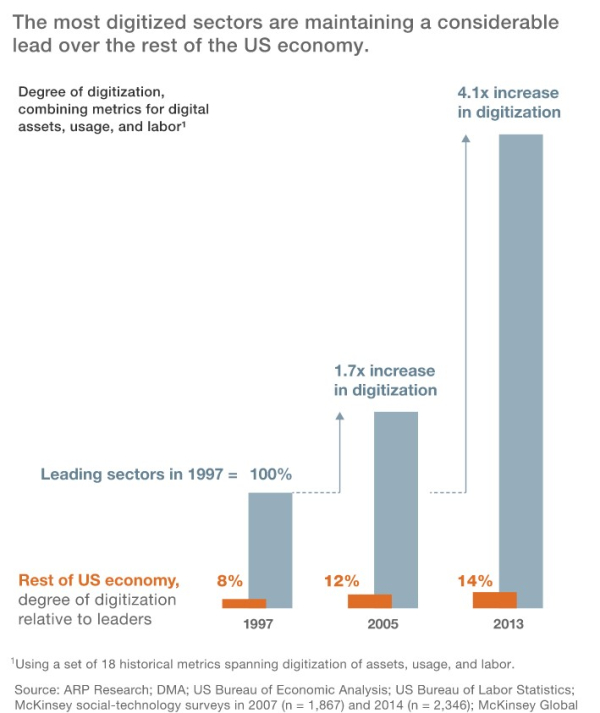
The Top 20 Tech companies are pretty easily recognized – tech giants like Apple, Facebook, and Alphabet top the list.
There are a lot of commonalities between successful tech companies. Pretty much all of them attempt to leverage software to do jobs that would be too expensive, too boring, or virtually impossible to do otherwise.
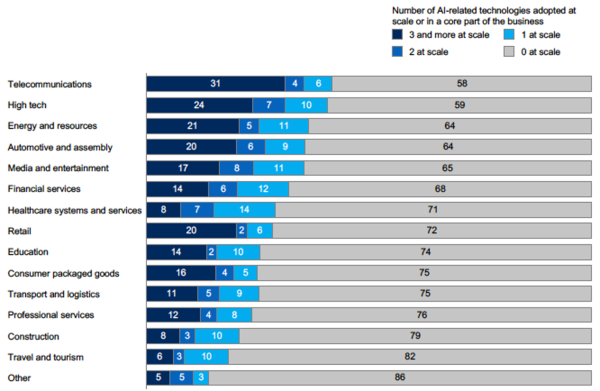
Obviously, technology is a huge force factor impacting the success of a company. As a result, there is an arms race to get to "next" …
via Bloomberg
Research and Development has always been a key in growing companies. Now, that is truer than ever. As tech improves faster and more dramatically, technologies become relevant and irrelevant faster than ever.
Challenging … sure, but a great problem to have.
What a great time to be an entrepreneur!
Good luck with your 2018 plans. I'd love to hear what you are focusing on next year.
We've gotten used to the freedom to use the internet. It's considered a commodity. You expect "Net Neutrality," the principle that prohibits internet service providers from speeding up, slowing down or blocking any content, applications or websites you want to use.

That's currently at risk. You can find out more about Net Neutrality, and the repeal, here.
Here are some of the posts that caught my eye recently. Hope you find something interesting.
Thanksgiving was this week. Hope you had fun.
I was lucky enough to spend time with family and friends watching the Cowboys make the Los Angeles Chargers look good.
My mother always used to lead the table in answering "What are you thankful for?" After the groaning subsided, we would answer. Typically, the focus was predictable – family, togetherness, and health.
Those answers neglect a pivotal part of our happiness. People often view happiness or gratitude as a consequence of their surroundings … of good things happening in the world around them.
A different, but potentially related question is … does money buy happiness?
I asked my son, Zach, to answer … Here is what he compiled.
Happiness is a complex issue. It differs from culture to culture, and more granularly from person to person.
One of the more basic questions is, where are the happiest people?
Unfortunately, finding out where the happiest people are doesn't tell us how to be happy. In fact, there's a whole section of economics called Happiness Economics that strives to figure it out.
Most studies show that money doesn't buy happiness … above a certain point.
The studies show that there's an income level (relative to your cost of living) where increased money does not increase happiness. For example, in Hawaii, it would be $122,175, but in Mississippi, the threshold is only $65,850. Essentially, past subsistence, other factors matter more. Quality of life and work/life balance being two key ones.
The Easterlin Paradox states that while individuals in higher GDP countries were more likely to report happiness, it doesn't hold at a national level, creating the paradox.
The existence of a hedonic treadmill - or set point of happiness – may be up to debate, but this hits on an important distinction. Most people start yearning for money as a means of protection and care for themselves and their families, but don't change their goals once they've accomplished that.
If obtaining more money comes at the cost of your happiness is it worth it?
Finding the right balance can be hard. With most high-achievers, there's always a best next step, a new mountain to climb, a tougher challenge to surmount … and nothing is ever enough.
While achievement drives me as well, I think the story below is worth considering below.
The Story of The Mexican Fisherman:
An American investment banker was at the pier of a small coastal Mexican village when a small boat with just one fisherman docked. Inside the small boat were several large yellowfin tuna. The American complimented the Mexican on the quality of his fish and asked how long it took to catch them.
The Mexican replied, “only a little while. The American then asked why didn’t he stay out longer and catch more fish? The Mexican said he had enough to support his family’s immediate needs. The American then asked, “but what do you do with the rest of your time?”
The Mexican fisherman said, “I sleep late, fish a little, play with my children, take siestas with my wife, Maria, stroll into the village each evening where I sip wine, and play guitar with my amigos. I have a full and busy life.” The American scoffed, “I am a Harvard MBA and could help you. You should spend more time fishing and with the proceeds, buy a bigger boat. With the proceeds from the bigger boat, you could buy several boats, eventually you would have a fleet of fishing boats. Instead of selling your catch to a middleman you would sell directly to the processor, eventually opening your own cannery. You would control the product, processing, and distribution. You would need to leave this small coastal fishing village and move to Mexico City, then LA and eventually New York City, where you will run your expanding enterprise.”
The Mexican fisherman asked, “But, how long will this all take?”
To which the American replied, “15 – 20 years.”
“But what then?” Asked the Mexican.
The American laughed and said, “That’s the best part. When the time is right you would announce an IPO and sell your company stock to the public and become very rich, you would make millions!”
“Millions – then what?”
The American said, “Then you would retire. Move to a small coastal fishing village where you would sleep late, fish a little, play with your kids, take siestas with your wife, stroll to the village in the evenings where you could sip wine and play your guitar with your amigos.”
Finding your own personal brand of happiness is vital … to your success, your companies success, and the success of your relationships, and I was reminded of a video my dad shot on zero-based thinking.
To be happy, or successful, are there things you need to stop doing? Something you want to start doing? Or things you need to do more of? Food for thought to pair with your leftovers from Thanksgiving.
Happy Thanksgiving!

via Dilbert
Here are some of the posts that caught my eye recently. Hope you find something interesting.
Which came first … the chicken or the egg?

DR-ROBERT-J via Reddit
A good reminder that there's a difference between correlation and causation.
Still an interesting chart. What do you think the confounding variables are?
There's a paradigm shift happening in trading.
Today's investors have access to data and information that would have been unheard of 10 years ago … and unfathomable 20 years ago. In the past, investors relied on information and experience from their real lives, from counterparties, and from fastidious attention to CNBC and stock tickers.
However, fundamental discretionary traders account for just 10% of today's trading volume. Quantitative investing based on machine intelligence and algorithms is the new normal.
While the games, the rules, and the players have all changed, the goal hasn't … more alpha … more money … more reliably.
What's Changed?
Algorithmic trading isn't new, but there is a shift in who's making the algorithms. For example, you can crowdsource development through Quantopian … or let machines do the heavy lifting through A.I.-based firms like Sentient.
Some argue that artificial intelligence is unable to generate significantly different results because "analyzing more and more data results in increasingly similar strategies".
But I'd argue that's only true if you look at the same data, the same way.
The Future of Trading
One of the reasons A.I. is a great option for trading is that it takes away the human element of fear, greed, and discretionary mistakes.
Sentient's founder says:
"For me, it's scarier to be relying on those human-based intuitions and justifications than relying on purely what the data and statistics are telling you." – Babak Hodjat
In addition, people tend to get similar results because they do things similarly. As A.I. matures (and more researchers become better versed in what's possible) solutions will evolve.
It won't be a Ph.d. writing an algorithm … it will be machines and code trying unthinkable combinations and finding edges that otherwise would remain invisible and unused.
Currently, most people train their algorithms on markets, or with human intervention, but there are more data sets that can be used to build more robust models.
Alternative Data
Alternative data, to most, means tracking Twitter and Facebook sentiment, but confining your definition to that limits potential alpha.
New sources of data are being mined everywhere, and are letting investors understand trends "before they happen".
For example, mobile devices, low-cost sensors, and a host of new technologies have led to an explosion of new potential data sources to use directly for predictive insight or indirectly to help improve models.
In addition, private company performance, logistics data, and satellite imagery are becoming popular data sets in a data scientist's alpha creation toolbox.
There are often concerns about the cost and completeness of these datasets, but as we get better at creating and using them, both will improve.
Here is a chart of alternative data sources.
via CBInsights
Finding more ways to train algorithms on new data can help traders once again find an edge on their competition.
The thing about "sustainable alpha" is that while one might be able to achieve it, you can't expect to have it doing the same thing everyone else, or that you've always done.
Markets change, and what worked yesterday won't necessarily work today or tomorrow. Trading is a zero-sum game, and as we move toward the future, this only gets more apparent.
Behavioral Game Theory shows that human choices don't necessarily reflect the benefits they expect to receive. That's no longer the case with algorithms.
For more on Big Data and its potential, here's access to the full panel discussion I participated in recently at The Trading Show in New York.
via YouTube
Let me know if you have questions or comments. Thanks.