|

|
|
|
|
|
|
|
|
|
|
|
|
|
|
|

Thoughts about the markets, automated trading algorithms, artificial intelligence, and lots of other stuff
Here are some of the posts that caught my eye recently. Hope you find something interesting.
Crowdsourcing is gaining momentum.
One of the first big crowdsourcing wins came through Peter Diamandis's X Prize platform. Their stated mission is to bring about "radical breakthroughs for the benefit of humanity" through incentivized competition.
In 2004, the Ansari X Prize for Suborbital Spaceflight was awarded, and the personal spaceflight industry began.
Today, space exploration isn't just government funded. You've got players like Jeff Bezos, Richard Branson, and Elon Musk investing billions in it.
All because of a "little" competition.
HeroX is a clever offshoot of this idea, where complex problems are solved (and new innovations are created) by crowdsourcing competitions.
Click here to see their current challenges.
I spent some time this week with Christian Cotichini, co-founder, and CEO of HeroX. Watch this three-minute video to get an idea how crowdsourcing is becoming more mainstream and powerful.
Howard Getson via Youtube
Crowdsourcing is a terrific way to supplement an innovation funnel.
We are investigating how to best leverage platforms like this.
Let's talk if you have ideas.
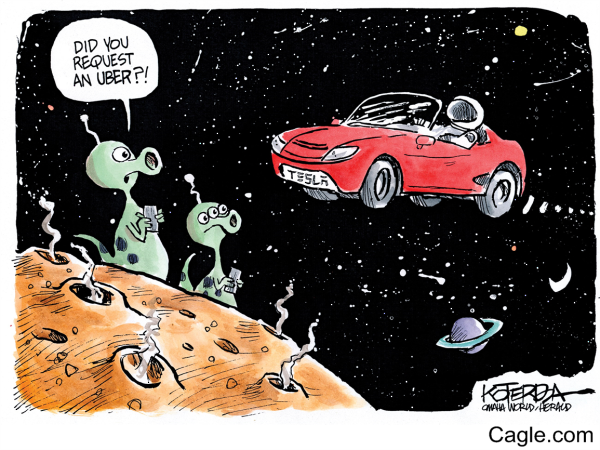
Last Tuesday, Musk launched his Tesla Roadster and it's passenger "Starman" into space on his Falcon Heavy rocket.
Cool? Clever Marketing? Or Both?
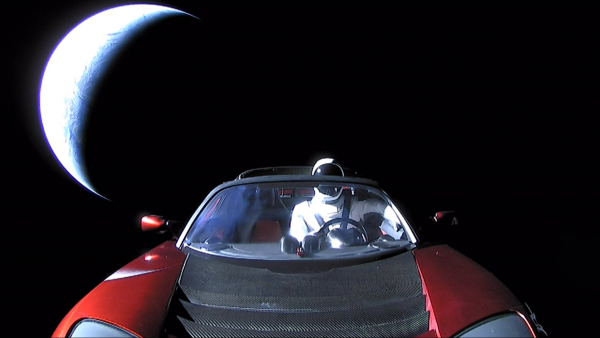
Space via Twitter
This feat is exciting for a number of reasons.
When I was growing up, the space race caught the public's hearts and minds. I was a kid, but I still remember watching the lunar landing. It was a big deal!
Likewise, I remember when astronauts were positioned as national heroes. Now, we're more jaded.
In the past decade, rockets, space-stations, satellites, etc. were often just an afterthought or a small filler news item. Meanwhile, A.I., Cloning, Voice Recognition, 3D Printing, Drones, and other technological advances were the sexy attention-getting topics.
Recently, that has changed. The space race is getting hot again. Resources are pouring into this area, and SpaceX's launch is proof that we are making progress (and probably altering life's history).
Take a look.
This was supposed to be captivating. Teachers can show their students a rocket launch where a man shot a car into space … then they can watch the car float through space. It's taking what we're used to only seeing in movies … and making it real.
Passion in the sciences is important, and successes like this can ignite passion in our future, in more than just space exploration.
We live in exciting times.
Onwards!
The adoption of Artificial Intelligence by more industries, and it's subsequent advances, raise a lot of questions.
For example, Saudi Arabia recently gave "Sophia the Robot" citizenship. That makes Saudi Arabia the first country to grant a robot citizenship. This isn't the first time non-persons have been granted the rights of a citizen, but it does raise questions.
Another question I hear more often is:
How long until the machines are better at my job than me?
Automation used to mean big, bulky machines doing manual and repetitive work, but today, automation can land aircraft, diagnose cancer and trade.
Kurzgesagt, a YouTube channel specializing in explaining things "in a nutshell" took on the new wave of automation. It's a little long at 11 minutes, but it's worth watching.
Kurzgesagt via Youtube
Kurzesegast asserts that in the past, innovation created new industries or allowed increased scale … but the number of jobs the internet and Artificial Intelligence create aren't matching the number of jobs they're making obsolete.
According to this study, approximately 50% of jobs will be automated by 2034.
Personally, I believe that freeing us to do more has always been a boon to society. Electricity put a lot of people out of work as well. Nonetheless, look what it made possible.
To date, human progress has been based on the division of labor. As our society progressed, our jobs have become more and more specialized. Now, machines will be able to break-down complex jobs into simple parts and complete them faster than we can.
Machine Learning is being done faster and better. And you can bet that will only become more true. So, yes, the same technology that's currently creating opportunities could eventually put you out of a job … but it also creates an opportunity for something new.
Basic concepts (like what constitutes a person and which things are alive) are not so basic anymore. And the implications are fascinating as well. For example, people are discussing the taxation of robots, a Universal Basic Income, and even One-Child Policies.
There's a lot of change coming, and that can be scary, but there's plenty of reason to be excited as well.
We live in a golden era of innovation, and we have longer life-expectancies than ever before.
We truly live in interesting times!
Cloning primates … What could go wrong?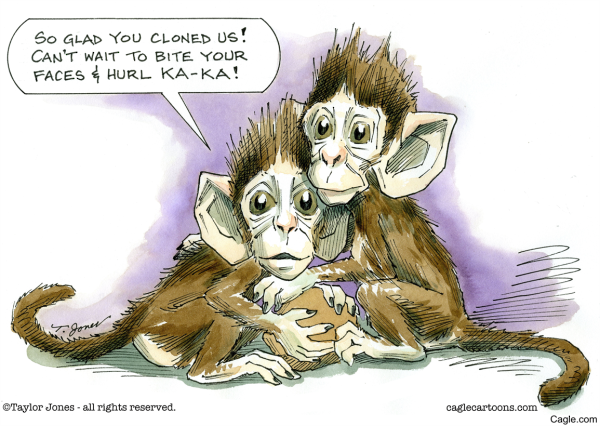
Here are some of the posts that caught my eye recently. Hope you find something interesting.
Do you remember Dolly the Sheep?
She was the first mammal cloned "from an adult somatic cell, using the process of nuclear transfer."
Dolly was cloned from a mammary gland and was named after Dolly Parton … for obvious reasons.
Since then, many other large mammals were cloned, including pigs and horses.
TIME via Youtube
It was just announced that Chinese scientists have cloned two long-trailed macaques using the same technique that produced Dolly.
Since humans are primates as well, this is an exciting, and mildly terrifying, step towards cloning humans.
Pragmatically, this bolsters medical research by making it possible to study diseases on uniform subjects, but it also raises tough questions on human cloning.
As A.I. and cloning advance, some tough bio-ethic issues will take front stage. It is time to start thinking about what defines a person (or even a living creature) and what rights they have.
Innovation stops for no one … and Nature finds a way.
Onwards!
Guys
I know it's late notice, but a friend of mine has two tickets for the Super Bowl in Minneapolis, MN at the new U. S. Bank Stadium on Sunday, February 4th. They are box seats and he paid $3,500 per ticket, which includes the ride to and from the airport, lunch, dinner, a $400.00 bar tab and a pass to the winner's locker room after the game.
What he didn't realize when he bought them last year was that it's on the same day as his wedding.
story hat-tip to JW.
If you are interested, he is looking for someone to take his place. It's at St. Paul's Church at 3 p.m. Her name is Ashley. She's 5'4", about 115 pounds, a good cook, loves to fish and hunt and will clean your truck. She'll be the one in the white dress.
Saw this and thought it was funny.
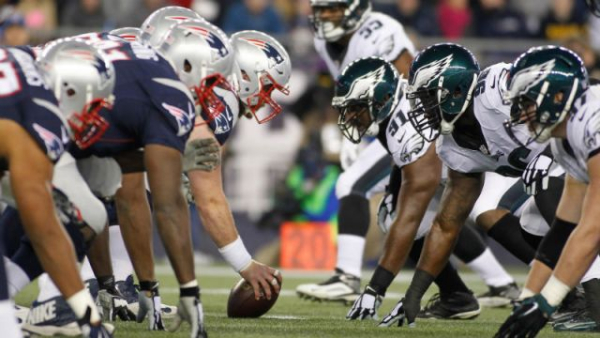
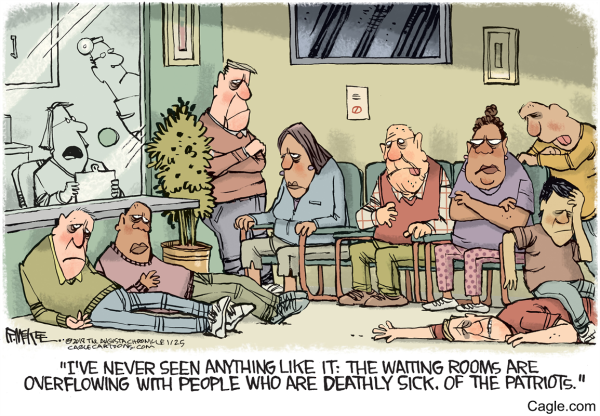
Who do you think is going to win the Superbowl? Patriots or Eagles?
Here are some of the posts that caught my eye recently. Hope you find something interesting.