|
|
|
|
|
|
|
|
|
|
|
|
|
|
|
|

Thoughts about the markets, automated trading algorithms, artificial intelligence, and lots of other stuff
Guys
I know it's late notice, but a friend of mine has two tickets for the Super Bowl in Minneapolis, MN at the new U. S. Bank Stadium on Sunday, February 4th. They are box seats and he paid $3,500 per ticket, which includes the ride to and from the airport, lunch, dinner, a $400.00 bar tab and a pass to the winner's locker room after the game.
What he didn't realize when he bought them last year was that it's on the same day as his wedding.

story hat-tip to JW.
If you are interested, he is looking for someone to take his place. It's at St. Paul's Church at 3 p.m. Her name is Ashley. She's 5'4", about 115 pounds, a good cook, loves to fish and hunt and will clean your truck. She'll be the one in the white dress.
Saw this and thought it was funny.
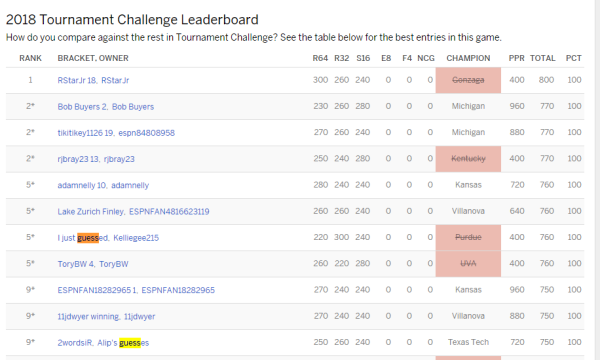
Who do you think is going to win the Superbowl? Patriots or Eagles?

Here are some of the posts that caught my eye recently. Hope you find something interesting.
Each sport has a different ratio of ethnicities. You might expect more Pacific Islanders in Rugby or Caucasians in Golf.
So what happens when you average the top players' faces in various sports?
As you might expect, you get very different results depending on the sport. See what I mean?
Not particularly surprising.
What is worth noting, however, is that while you may be thinking "this player must be unstoppable" … statistically, he's average.
The "composite" NBA player would be the 112th best player in the league. He's the fourth best starter on an okay team.
We found the same thing with our trading bots. The ones that made it through the most filters weren't the star performers. They were the average bots that did enough not to fail (but failed to make the list as top performers in any of the categories). The survivors were generalists, not specialists.
The reminder is that you won't find exceptional specialists if your focus is on generalized safety.
Onwards.
Last year, I talked with the CEO of CB Insights about how Fintech was disrupting the value chain of financial services.
Since then, it's become even easier to see how disruptors are changing every industry, and becoming leaders in their fields.
via McKinsey
Companies like Lyft, Tesla, and Netflix changed paradigms and are now leading the pack, but what industries are next?
Looking at a report by McKinsey&Company, we find that the 5 industries with the least digitization account for 34% of GDP and 42% of all employees.
via Quora
But, being less digitized than competitors, alone, isn't enough to indicate it's ready for disruption:
How Regulated Is The Industry?
Heavily regulated industries mean that any company that can find a way around current regulations and tax structures can become an effective competitor fast … i.e Lyft and Tesla
Is There Too Much Competition Already?
How many competitors are in the space? Is there spare capacity, or does the current model waste resources? Think taxis waiting for customers or empty seats on airplanes.
Can it Be Automated?
Lot's of industries and tasks are ready and waiting to be automated – and only haven't been due to the cost of switching to new technology.
To put it another way – are you solving a customer headache while lowering costs for you and the customer?
The only constant is change, and digitization and automation are only increasing the rate of change. The type, quality, and the number of jobs being offered are changing rapidly.
As digitization increases so does adoption of AI-related technologies.

McKinsey Institute via Vox
AI is coming, disruption is coming.
It's no longer possible, it's not even just probable, it's inevitable
This interactive graph tells you if your job is automation proof, and what percentage of your job can be automated.
What industry do you think is next?
It's day 2 of the government shutdown; but what does that actually mean?
In short:
Efficiency at its finest … or a force function to get the children to play nicer with each other?

Here are some of the posts that caught my eye recently. Hope you find something interesting.
This week I went to Chicago to speak at my old alma mater – Kellogg.
It was great to talk with professors and spend time with MBA students interested in trading and how the business of trading is changing.
I plan on spending more time there to benefit research and recruiting.

Unsurprisingly, deep dish pizza is still delicious. We were going to eat at a steakhouse. However, Jennifer and I remembered that the only thing better than gorging on meat … is gorging on meat and cheese.
While some things haven't changed, others have.
The Universe must be trying to tell me something. The day I got back, I found my old ID card … and, apparently, some things have changed in the past thirty years.

Onwards.
Machine Learning algorithms are everywhere.
They're helping you pick out your next gift on Amazon, controlling what you find on Google, they're suggesting new music for you on Spotify, and they're doing their best to keep you on their website.
When trying to explain how machines learn we tend to try and describe it in human terms. Unfortunately (or fortunately) machine learning isn't based on how we teach humans.
The video is a bit simple in its explanations, but it describes some important concepts. So, watch how machines learn.
The video focuses on Genetic Algorithms, which is one type of machine learning, and neglects some of the other more complicated approaches.
As machine learning gets more complicated and evolved, it gets harder for a human to understand what makes it good … and that's okay.
It's human nature to feel safer when we understand something. It's human nature to envision machines as making human-like decisions, just faster.
Of course, just because it suits human nature to believe something, that doesn't make it true.
Part of what makes machine learning exciting is that it can do a lot of things well that humans are really bad at.
In reality, it doesn't matter why a bot is making a decision, or what inputs the bot is making the decision on. What matters is the performance and level of decision-making in relation to itself and to other options.
One of the lessons I teach when I speak publically is that in trading, caring about the markets is a weakness.
It's a distraction.
I don't care how markets are doing.
I care how my systems are doing. I care how my portfolio is doing.
There's too much data for me to try and care about anything else.
It's a brave new world, and not only is big brother watching, but algorithms are too.