
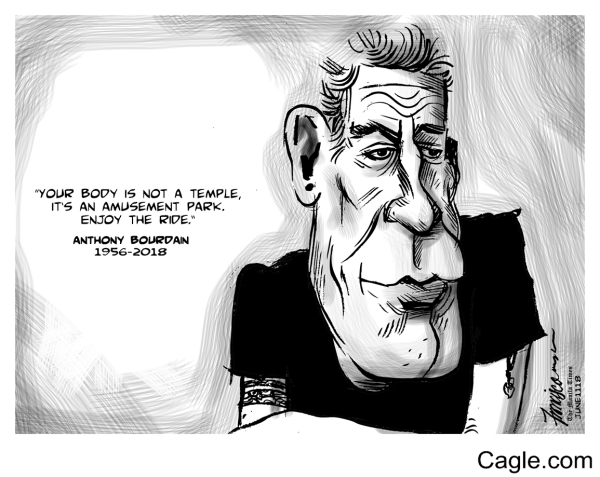
The average life expectancy for men in the U.S. is 76.
How many amazing vacations do you have left? How many jaw-dropping moments? How many fantastic meals? How many Super Bowls?
What about time with your parents or older relatives. It's easy to forget to call, or to miss an important event because "life happens" but if you realize you may have already used 95% of your in-person time with that person … doesn't it become more special?
In my TEDx talk, I mentioned "living like you only have a year left," and how much more "life" we got out of the last part of my dad's life.
That is an example, but I want to take it one step further.
To start, think of some of the activities you do, places you go, experiences you have that are special and make you feel like your best self.
Hitting flow-state and creating something new and exciting;
Taking an amazing vacation and experiencing something completely new;
Having a moment with someone you love that makes you stop and say – Wow!
Making a difference in someone's day or giving back to your community;
Experiencing peace and relaxation;
Feeling pure joy.
It's easy to get lost and take for granted these moments when they happen, but when you think about how much time you have left they take a whole new meaning.
How can you maximize the time you have left? Fill it with the best experiences, activities, and people you can.
To start, think about different time frames:
What activities could you commit to doing at least once a year?
What activities could you commit to doing at least once a month?
What activities could you commit to doing at least once a week?
What activities could you commit to doing at least once a day?
Make those lists … it is a simple way to get a better return on the time value of your life.
Seriously, try it.
Let me know how it worked for you – and what you chose.
I'm currently on the east coast for a family celebration … and a funeral.
Life and death.
Death is often a trigger that sends my thoughts spinning: celebrating life; mourning death; imagining what lies in store for the family; empathizing with the survivors … and even future-pacing to my own death and memorial service.
In daily life, I often remind myself that ‘everything happens for a reason’ – and just because I can't find the gift in a particular situation, doesn't mean it isn't there.
For example, when my Dad died, I came out with a new-found respect for how precious life is. I decided it was time for me to stop thinking about what I do – and spend more time cultivating who I want to be. It also caused me to consider how I would be remembered – versus how I'd choose to be remembered?
Death is often a reminder to make the most of the time given to us.
It was a reflection on my personal struggle with juggling work-life balance. It was about a year that brought my Dad's death, the forced sale of my company by venture capitalists, and a divorce (in that order). Luckily, sometimes, life's darkest days bring the greatest gifts … if you are willing to look for them.
One of my biggest takeaways from that struggle was about the time value of life.
In finance, the "time value of money" refers to the principle that the purchasing power of money varies over time (meaning, money today has more purchasing power than money later). In part, this is because the value of money at a future point in time might be calculated by accounting for other variables (like interest earned, or inflation accrued, etc.).
It occurred to me that a similar calculation applied to life … or living.
The above video is 13 minutes. Hopefully you'll watch; but if not, I've added some of my favorite excerpts below.
Live Like You Only Have a Year Left.
"During the last part of my Dad's life, I think he would have done almost anything for a little more time.
Things that used to be unimportant, or even mildly irritating, took on increased importance. For example, a dinner together became almost a sacred event; a kiss goodnight was truly heartfelt; and saying goodbye meant something … because it could be the last time.
Nevertheless, as a result of that focus, he took more life out of that time.
Shouldn't we do the same thing? Think about it … We are never going to be younger than we are, right now. We are never going to have more time to fix a big mistake. Isn't it likely that the time value of your life, is worth maximizing?"
People Who Are Good Take Advantage of Opportunities. People Who Are Great Create Them.
"When I think back to that year, I spent so much time moving away from pain … that I forgot to move towards opportunity. I feel like I wasted so much time.
My Dad said the difference between good and great is infinitesimal. People who are good take advantage of opportunities … But people who are great create them.
I think what he meant was that when they see the opportunity, they move towards it. They shoot through it.
It is easy to say, "I see that opportunity; but it's not the right time." Or, "I see that opportunity, and I really want to remember it for when this is over." And as much as I want to believe that's true … deep down, I know that it's always a good time to take the right action.
Instead, "life" (the noun) often gets in the way of "living" (the verb).
To Change Your Life, Change Your Perspective.
"When you are 'stuck' … a shift in role, or a shift in perspective, is often all you need to see a new path forward or a new possibility.
Have you ever been stuck playing a role that you knew didn't serve you? Where you knew what the best next step was, from your perspective, but you had a sense that it wasn't the right action? Sometimes it makes sense to step back and ask, 'What role can I play that would get a better result?'"
That is often all it takes to change the game. Other times, what it takes is the decision to play a new game.
That is why I called the talk: The Time Value of a Life Worth Living.
Thanks for letting me share that with you.
I also wrote a three-part blog series on creating the TEDx talk.
Part 1 focuses on my preparation leading up to the event.
Part 2 elaborates on the differences between a normal speech and a TEDx thought. And,
But TV viewership has dropped over 50% … and that's not a sustainable model anymore.
Luckily, like a true "Shark" he realized something that many people don't…
You have to be committed to your goals, not the tools you use to accomplish that goal.
I shot a video with Kevin where we talk about that … and more. Check it out
If you have been doing the same thing for 18 months (or longer), chances are the practical realities of time, technology, and a changing competitive landscape implies that you should be doing something different (or at least differently).
What are you doing to stay relevant in your space?
When I think about World Leaders (in places like North Korea, Russia, or Syria), I recognize how lucky we are to be able to elect our leaders in fair and free elections.
Unfortunately, that's not an opportunity that we take advantage nearly enough.
America has a two-party system, and we count our votes down district and state lines to decide which candidate will end up with the electoral votes for that state … but what if abstention was counted as a vote for nobody?
It's an interesting exercise to visualize what our absenteeism in voting looks like … in the last presidential election, four times as many voted for nobody as for Trump and Hilary (combined!).
For all the people who whine and moan in any Presidency, you'd expect more people would have taken action to support their beliefs.
Now, try to imagine how few people vote in the more minor election cycles.
There are many interesting practical and theoretical discussions to be had about voting – engagement, education, etc. – but looking at this graph certainly puts one of the problems into perspective.
It's easy to point out a problem. It's more productive to propose a solution.
Making election day a national holiday?
Allowing mail-in or digital ballots?
Many individuals feel they don't need to vote because their state uses an "all or none" electoral college approach, or because they feel they already know how their state is going to vote.
In addition, unless you're in a battleground state – it can often feel pointless – whether or not it is.
What do you think it would take to increase turnout?
What does it take to transform a vivid vision to a revolutionary reality?
Disney calls it 'Imagineering'.
What follows is a simplified version of the process Walt Disney Imagineering uses when it designs and builds theme park attractions, resorts, and other venues.
There are seven pieces or stages in the process. Five stages form the core of the process, while the other two serve as its Prologue and Epilogue.
Prologue: Needs, Requirements, and Constraints: Before the process actually begins, you must identify the project’s specific Needs, Requirements, and Constraints. These form the core parameters of your project.
The goal of the Prologue is to define your overall objective, including what you can do, can’t do, and must do when developing and building your project.
Blue Sky: The initial stage of any Imagineering project is the Blue Sky stage, where initial ideas and concepts are created through a combination of brainstorming and concept design.
The goal of the Blue Sky stage is to create a vision with enough detail to be able to explain, present, and sell it to others.
Concept Development: Once a concept born from the Blue Sky stage has been selected for development, it undergoes a period of concept development where the idea is more fully fleshed out and realized.
The goal of the Concept Development stage is to develop and flesh-out your vision with enough additional detail to explain what needs to be designed and built.
Design: The Design stage is where detailed design documents and specifications are created that will guide the physical construction of the project. These can include architectural documents (blue prints, plans, elevations, etc.) but also more Imagineering-specific documents such as Show Information Guides (documents that outline the story behind the attraction).
The goal of the Design stage is develop the plans and documents that describe and explain how your vision will be brought to life.
Construction: The last major stage of the process involves the actual physical construction of the project, including land development and fabrication.
The goal of the Construction stage is to build the actual project, based on the design developed in the previous stages.
Models: At each main stage in the process, the Imagineers build models of various sizes and scales to help identify and solve potential design challenges.
The goal of creating models and prototypes is test and validate your design at each stage to help solve and/or prevent problems that may arise during the design and construction process.
Epilogue: Openings, Evaluations, and Show Quality Standards: Once construction is complete, the attraction is opened for Guests (including Cast Member previews, Soft Openings, and finally a Grand Opening). In addition, once in operation, the attraction is periodically evaluated to ensure that it maintains a level of quality and that the original Creative Intent of the attraction is intact.
The goal of the Epilogue is to present your project to your audience, allow them to experience it, and evaluate its success and effectiveness over time.
Our physical and virtual realities are beginning to blend. Animation is becoming more realistic. Virtual and augmented reality are becoming more affordable. Wearables are becoming pervasive. And, the internet of things will soon overtake the Internet.
We're moving towards a world where technology envelops every aspect of our lives … figuratively and literally.
The following (still fictional) video is thought-provoking. What happens when these new technologies are used to influence behavior, decision-making, and even your identity?
Virtual reality (VR) and augmented reality (AR) are not new fields – but, they are evolving quickly. Technology and infrastructure are getting to the point that AR and VR will become common for us.
You have already started to see it (from Google Glass, to the NBA, and of course, to porn).
"Not too far in the future you will begin to see the integration of AR and VR together eventually leading to having your favorite performer on your lap, in your bedroom doing a custom performance for you and responding to your verbal and physical cues."
Your doctor or nutritionist could help you make better choices for you. Your therapist or coach could help you perceive and respond differently to the challenges life presents you. Marketers could better influence your purchases. Employers could better monitor and measure your performance and productivity. And governments will not be far behind … doing what they do.
Like many things, these technologies make possible awesome new capabilities (if used well) and horrific consequences (if abused or used in authoritarian ways).