Thoughts about the markets, automated trading algorithms, artificial intelligence, and lots of other stuff

  • Happy Ten Year Anniversary to the Bull Market!

    On March 6th of 2009 the S&P 500 bottomed out at 676.53 points. We've seen several ups and downs since then, but the Bull market has remained strong.  The S&P has risen by approximately 309%

    Here's a video from CNBC on that fateful day in 2009 … it's an interesting look into the past. You'll recognize a lot of the faces, but not a lot of the prices. 


    Cy McCaffrey via Reddit 

    As people struggle with fear & future uncertainty, this video feels oddly apropos. The Great Recession seems so far removed, but this video calls forth that same feeling.

    Ultimately, human nature remains a constant.

    Meanwhile, the bull market has been remarkably resilient through a variety of shocks, fearmongering, divisive politics, and volatility. Despite vulnerability & large drops at the end of 2018, the bulls managed to barely weather the storm. 

    Currently, the economy is strong and the Federal Reserve is pausing interest rate increases. Yet, predictions of the economy slowing, earnings decreasing, and global trade uncertainties have many afraid.

    Are those an omen of a recession, more fake news, or just part of the playing field?  Time will tell.

  • The Too True Story of “The Nail in a Fence”

    In the course of business this week, I noticed that certain comments and interactions triggered hurt feelings.

    Stress, high expectations, and a narrow focus often result in hurt feelings.

    Of course, I understand that a little conflict is normal (or even beneficial).  Yet, I guess I'm getting a little softer as I get older.

    It doesn't take "intent" to hurt someone's feelings (or to have your feelings hurt).  It can happen by a simple disagreement, a stubborn point of view, a dismissive comment, or even a judgmental look.

    Sometimes, the catalyst can be part of effective strategies.  And normally, people just brush off these smaller-scale disturbances with the excuse with: "I was angry"; or “I’m only human”; or "There is no place for cry-babies in business."  Nevertheless, it’s important to remember that we should strive to be better.

    To drive the point home further, here is the story of "The Nail in a Fence."  While you might have seen it before, it is worth reading again. 


    Nail In The Fence:


    Nail in woodThere once was a little boy who had a bad temper. His Father gave him a bag of nails and told him that every time he lost his temper, he must hammer a nail into the back of the fence.

    The first day the boy had driven 37 nails into the fence. Over the next few weeks, as he learned to control his anger, the number of nails hammered daily gradually dwindled down.

    He discovered it was easier to hold his temper than to drive those nails into the fence.

    Finally the day came when the boy didn't lose his temper at all. He told his father about it; and the father suggested that the boy now pull out one nail for each day that he was able to hold his temper.

    The days passed and the young boy was finally able to tell his father that all the nails were gone.

    The father took his son by the hand and led him to the fence. He said, "You have done well, my son, but look at the holes in the fence. The fence will never be the same. When you say things in anger, they leave a scar just like this one. You can put a knife in a man and draw it out. It won't matter how many times you say I'm sorry, the wound is still there."

    A verbal wound is as bad as a physical one.


    This story is a reminder to be mindful of cause and intent.  Hope it helps.

    Causing pain to others is one problem.  Causing pain to ourselves is another.

    Feeling and stoking anger is like taking poison and hoping the other person suffers.  It isn't efficient or practical.

    So, what about "Forgiving"?

    It doesn't have to be forgetting.  

    Forgiving removes the valence (or charge) from a situation or memory.

    It only takes a moment to create an emotional trigger (think about how you felt when you saw a high school bully in the hallway).  It is simple, evolution and natural selection favored species that remembered and avoided danger.  It is in our DNA.  But avoidance isn't always a great strategy … especially when it is blocking the attainment of something beneficial.

    Forgiveness is a way to disable or mute the emotional trigger (this is called "collapsing an anchor" in NLP). It's also a choice to move forward.

    Forgiveness is also a release of "claim".  When we are wronged, we expect an apology, retribution, restitution, or recognition.  And until we get it, we are stuck, waiting for it.  In a sense, forgiveness releases the stuck energy and makes it available for something else (hopefully, something better).

    Forgiveness changes the route and allows you to move forward.

    And I've found that good things happen more often when you are in motion.

    Who or what do you need to forgive?

    Onwards.
  • The Relationship Between Stock Exchanges and Indices

    Last year, I wrote about how the top 16 exchanges each have a market capitalization above $1 trillion.

    That's a staggering amount of money being traded; but, how much of is it traded well?

    82% of funds trailed their respective benchmarks over 15 years, and Indexes consistently beat stock pickers

    With the NYSE and NASDAQ being the two biggest stock exchanges, looking at them can provide a lot of insight. The NYSE has 2058 companies, and the NASDAQ has 2588. 


    5212017 stock-exchanges-and-indices

    via VisualCapitalist


    With active managers' struggle to beat the market, many investors have moved to index-tracking funds (as of last year, investors withdrew $1.2 trillion from actively managed U.S. funds since 2007, according to Morningstar). 

    My prediction, active management becomes a lot easier with AI and machine learning. You'll be hearing more about that from us soon. 

  • The Oxford Comma: Still Important, Even If Oxford Doesn’t Think So

    Grammar isn't everyone's cup of tea … but it's something I spend a lot of time thinking about. 

    Should I use an ellipsis here or a dash? Is this an unnecessary parenthetical?

    Because of that,  the serial comma (commonly known as the Oxford comma) is surprisingly important to me. 

    If you don't know what an Oxford comma is, it is the comma before the word "and" at the end of a list. 

    I love it (and use it). I think it adds clarity in most situations, and while some lists make sense without it, it is helpful if not necessary in many lists.

    Like below: 


    7142017 stalin

    Who wants that?

    Use the Oxford Comma …  Save yourselves the imagery. 

    If you need a guide of when to use it, Check out this infographic … Click it to see the whole thing. 


    7142017 oxford comma

    via PRDaily

  • Organs Organized Organically

    Sometimes Nature is cool!  Sometimes Science can be cool too!

    Here’s a video where both are cool together.

    Dutch director Jan van IJken filmed a beautiful microscope timelapse of a newt being born – from single-celled zygote to a complete organism. 

    It's six minutes (and you can skip around). Check it out. 


    Jan Van IJken via Aeon Video

    It's amazing to watch how complex growth is, and even more amazing that we get through without serious malformations. 

    The blueprints and templates, and the ability to make it happen, exist in such simple cells. For something so complex and "natural" to be so organized blows my mind. 

    For another impressive show of the organization and complexity of these fleshy prisons, here's a series of animations on DNA. 


    via WEHI

    Look how organized we are at the cellular level. Think how that organization grows into organs, and then brains, and then bodies … and then communities, and societies. 

    Imagine what we'll be able to accomplish when we grasp genetic engineering and regenerative medicine. Even our failures like diseases and cancer are systems – as we identify and understand them better we can fix and modify them (see CRISPR). 

    Crazy stuff!

  • Profound Population Proliferation

    Humanity is a force to be reckoned with. For better or worse, we've terraformed the world to our design. 

    It's interesting to see the ebbs and flows of populations – and how exponential today's growth is. 

    Watch the video. 


    American Museum of Natural History via Youtube

    It took 200,000 years for our population to reach 1 billion. It took 200 years to reach 7 billion. Our population has doubled since 1971.

    The video predicts that the earth's carrying capacity is about 11 billion and that we'll reach that by 2100.

    Farming took humanity from a couple million to hundreds of millions. Modern medicine and the industrial revolution took us from hundreds of millions to billions … and we're in the middle of a technological revolution. 

    When you think about how radically our population has grown in the past 200 years, it's no surprise the dynamics of our relationship with the world have changed. 

    You don't have to be an economist to predict the number of 18-year-olds in 15 years. You merely count the 3-year olds. India and China's influences are both going to grow due to the sheer number of people they have. Africa is slowly building megacities to accommodate the growing population with the help of China.  How else do you think this is going to impact the world order in the coming decades?


  • Funding Fintech’s Future

    I think it’s clear that Fintech is getting a lot of attention from the press, investors, and talent.  It is a hot space!

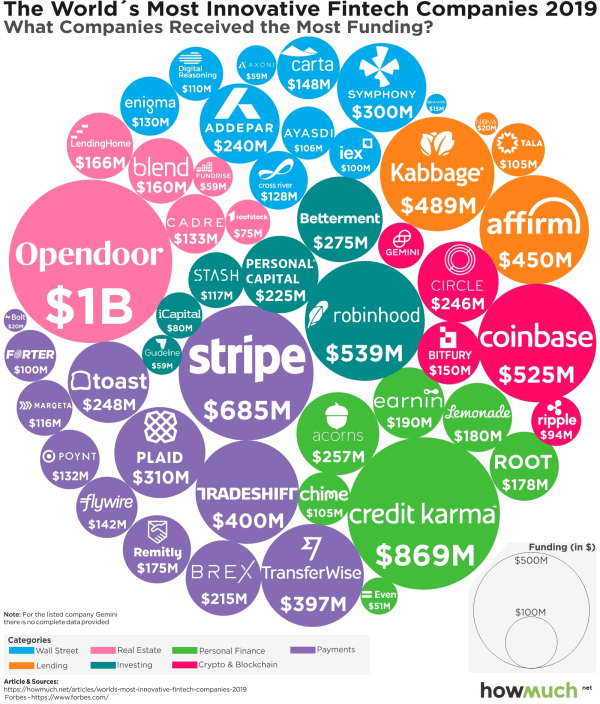
    Here is a chart showing the Fintech companies that got the most funding recently.


    Worlds-most-innovative-fintech-companies-2019-5b7c

    via howmuch

    Rapidly maturing sectors are payment processing, personal finance, and blockchain/crypto.

    • Payment Processing – Stripe received $685 million in funding last year and is valued at over $20B
    • Personal Finance – This is a broad market, but we're seeing the "average joe" empowered to make smarter personal finance decisions with companies like Robinhood, Acorns, and Credit Karma. Credit Karma raised $869M and is valued at approximately $4B
    • Blockchain – While crypto is currently out of favor for many, blockchain is still an exciting prospect. Opendoor is bypassing real estate agents and brokers to disrupt the housing market. Receiving over $1B in funding last year, it is currently valued at $3.7B.

    These are the sectors getting the most Fintech funding now (with payment processing the clear leader).

    In my opinion, real disruption is brewing in the personal finance & Wall Street sectors … and funding is ramping up there as we speak.

    This Fintech sector reminds me of biotech.   Solutions have to be more mature and fully-tested before unleashing them on the public.  But winners will Win!

    Wall Street is one of the smaller sections in this infographic.  Nonetheless, I think you'll be reading a lot more about this space soon.  Here are some of the companies worth noting.

    • Symphony  does secure communications for companies like JP Morgan and Goldman Sachs. It helps with internal communication, and client-centric communication, and has various bots and apps to decrease decision time. 
    • Addepar claims to "power the global financial system".  It's a performance reporting platform meant to provide better insights, and connect assets to goals. 
    • Carta does equity management; helping private & public companies manage their cap tables, investments, and equity plans. 

    Not seen on these lists are all the smaller companies at the beginning of their innovation cycle, and the companies doing their best to stay under the radar. More competitors and more opportunities mean more reason to keep your cards close to your chest. 

    The funding cycle is always two steps behind the innovation cycle, which means ideas we've been hearing about from the likes of Gartner will be seeing increased publicity soon. 

    I think 2019  will be a great year for innovation. What about you?