
Thoughts about the markets, automated trading algorithms, artificial intelligence, and lots of other stuff

  • Biohacking Gone Wild

    Dave Asprey is perhaps the most well-known biohacker (he's even referenced in Merriam-Webster's definition of biohacker) and the founder of Bulletproof. For those that don't know, a biohacker is someone who uses drugs and technology to make their body/mind function better. 

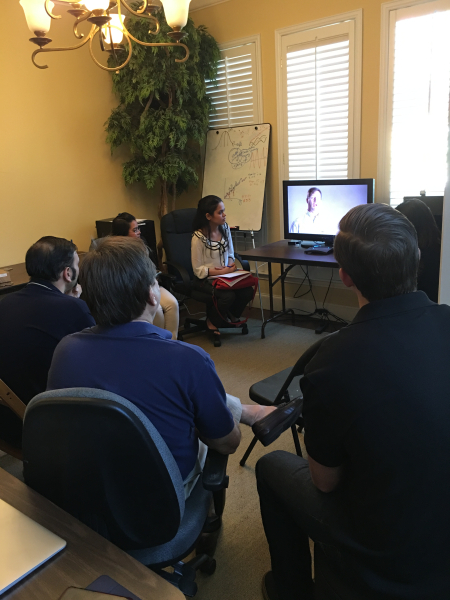
    Dave and I shot a video where he discusses life and provides an interesting take on algorithms


    It's not surprising that biohacking has become as popular as it has. In a society that encourages (maybe even necessitates) an impossible balance between work, responsibilities, and self-care – it makes sense to want to increase efficiency. 

    Biohacking helps you do more with less. Biohacking is popular because you're trying to get peak performance via the path of less resistance.

    Having trouble with sleep, but don't want to stop using your phone before bed? Wear blue-light blocking glasses. 

    Not getting enough results at the gym? Work out "smarter" not harder, by using cryotechnology and intelligent lifting machines

    While biohacking started as tricks like that – nootropics to help your mind, light and sound machines to decrease stress – it's becoming increasingly tech-centric and augmentation based. 

    Several months ago, I shared Gartner's hype cycle for 2018. Do-It-Yourself Biohacking was one of 5 encompassing trends for the year. 

    The future is bringing implants to extend humans past their perceived limits and increase our understanding of our bodies; biochips with the potential to detect diseases, synthetic muscles, and neural implants. – Howard Getson

    It's estimated that over 100,000 people already have various types of implants. In Sweden, thousands of Swedes are inserting chips under their skin to speed up their daily routines. They use chips to open locked doors, to store contact information, and to get on to the train. Currently, chips are limited to simple tasks like unlocking doors, holding personal data, and tracking simple to record data.

    Longterm, it's likely you'll see it moving toward exoskeletons, AR/XR experiences, and unsurprisingly to sex toys. It's also being used to create artificial organs and counteract memory loss.  The two companies that are leading this movement are NeuralinkBiohax International and Digiwell. While it's currently being adopted primarily by fast-movers and technocrats, it's pragmatic to think there will be more widely-adopted versions of this as technology gets standardized and protections are put in place. 

    For all the excitement, it's necessary to remain skeptical and patient. DIY biohacking raises various ethical issues, especially around data protection and cybersecurity. As a reminder, when it comes to cybersecurity, you "the user" are the biggest weakness.

    There's no stopping this train, but there is time to make sure it stays on tracks!

    Onwards!

    by the way, I highly recommend the Bulletproof product line!
  • Replicas: Deep Fakes and Voice Replication

    Fake news was scary enough … but now it is going to a new level.  Technology is going to make it harder to find the “signal” in the “noise”.

    Here is a preview of tech solutions (which already exist) that are likely to create a new set of problems and challenges for us in the future.

    Replica is a company whose goal is to replicate celebrity voices. They see this as enabling creative applications of their voices without the commitment of the celebrity – of course the owner of the voice that's being replicated would control when/where it could be used.

    Here's a video introducing Replica. 


    Combine that ability to simulate voices with deepfake technology (which can alter video in many ways, including to look like the mouth in the video is is saying the words that were simulated) and the potential for confusion or deception skyrockets. 

    Here is an example.


    My guess is that you will hear a lot more about this soon because of upcoming elections.  It will also become increasingly relevant in everyday life, business, trading, and legal situations.

    A picture used to be worth a thousand words, but this may change that equation forever.

  • If The Internet Goes Down Does The World Crumble?

    On Tuesday, for less than an hour, early in the workday, it felt like the internet was down for many.  The cause? Cloudflare went down. Cloudflare offers web services to over 16 million websites. That includes sites like HubSpot, Medium, UpWork, 9gag, Discord, Sirius XM, Shopify, Coinbase, Canva, Soundcloud, Buzzfeed, and Capitalogix.

    Even down detector was down. 

    D-eaixoW4AE7aE9


    That means when Cloudflare went down, so did a non-trivial portion of the internet. W3techs reports approximately 10% of the internet was affected by Cloudflare being down. 

    What happened?

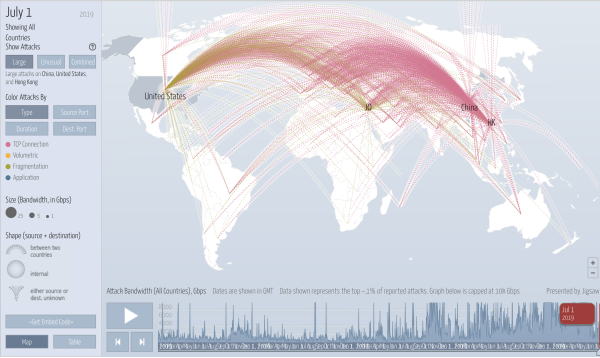
    Screen Shot 2019-07-02 at 9.47.13 AMvia DigitalAttackMap

    There was a massive spike in CPU utilization. At the time, it looked like a DDOS attack. People were speculating that it was a Chinese attack trying to mess with the Hong Kong protests. 

    Turns out, it was bad code – specifically, a single misconfigured rule within their firewall services. They did a global rollout of the code, and so it affected everyone. 

    This shows the importance of staged rollouts – testing your releases live with test groups before being released globally. 

    Here's a great write-up from Andy Ellis on preventative measures in the future.  

    The reality is, using a CDN is still helpful, Cloudflare's downtime doesn't mean you shouldn't use them.

    It does mean we should be thinking about what failsafes are needed to keep the internet infrastructure working in the event of attacks or failures. 

    Attacks are becoming more common, and as we now expect constant improvements/releases to software, we can expect more company errors as well. Facebook had similar issues on Wednesday.

    Think of how much relies on the internet as a backbone. It's crazy to think about the impact sustained downtime would have; billions of dollars in business not happening, banking systems down, etc.  Realistically, if the entire internet goes down we likely have bigger issues to worry about, but this event shows that large swaths of the internet could be affected at once. 

    Would a decentralized network help? Are smart contracts necessary for that? Is there a CDN for CDNs?

    It feels like we often end up with more questions than answers.

    It is why many companies opt for a hybrid cloud with plenty of on-premise compute.

    What do you think?

  • How Do You Compete Against Tech Giants? Moonshots.

    “I have not failed. I've just found 10,000 ways that won't work.” – Thomas Edison


    It doesn't make sense to challenge a bigger and better-funded competitor in an area where they have an asymmetric advantage.  In other words, don't compete with giants at their own game.

    Choose to play a game you expect to win.

    Playing a different game is a theme at Capitalogix. We believe that you control the game you're playing, that you control the rules, how you keep score, and even how you evaluate success.  These things inform where you spend time, where you invest money, and even what looks like an opportunity to you. 

    Wouldn't you rather compete in areas where you can create a unique sustainable competitive advantage?  Personally, I want to invest in extending an edge that lets us win.

    Why?

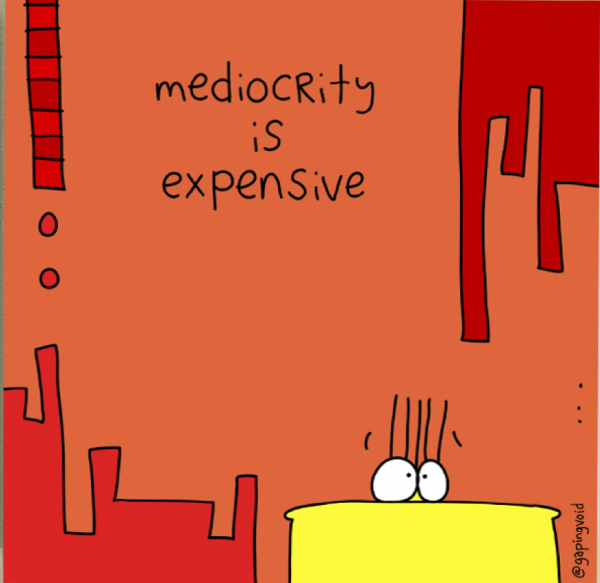
    Mediocrity Is Expensive!


    Mediocrity is Expensive_GapingVoid

    What you lack in size or computer power, you can make up for in creativity, agility, and innovation. 

    Capitalogix sought to create a niche in the investment industry, not through computing power, but through unique approaches to age-old problems. We use AI and data science to enhance decision-making. 

    We have an incredibly narrow and consistent focus.  Within that area, we are willing to take on problems others avoid and pursue goals that others say are impossible. 

    Our niche limits risk and lets us fail faster … and learn faster. This allows us to take confident action while others are tentative. 

    Most big companies – and most of our competitors – are afraid to be wrong. They have to protect their infrastructure, cash-cows, and short-term performance metrics.  It makes sense (from their perspective) that playing it safe means that you're secure in your position. – but that's not how it works. 

    You can't challenge the status quo when you are the status quo. 


    10x Improvement Is Often Easier To Achieve Than 10%


    Astro Teller via TED

    "In 1962 at Rice University, JFK told the country about a dream he had, a dream to put a person on the moon by the end of the decade.The eponymous moonshot. No one knew if it was possible to do, but he made sure a plan was put in place to do it if it was possible.That's how great dreams are.Great dreams aren't just visions, they're visions coupled to strategies for making them real." – Astro Teller


    Incremental change is hard – it's finding new ways to do the same thing, and you often end up competing in very red oceans – saturated markets where you're competing on price. Moonshots sound harder, but you end up with your own niche and the constraints of a new idea force creativity and energy.  If you're going after a goal that no one has accomplished before, it's impossible to be in a red ocean, and it's easier to mobilize a team around something exciting and new than decreasing some arbitrary metric 2%. 

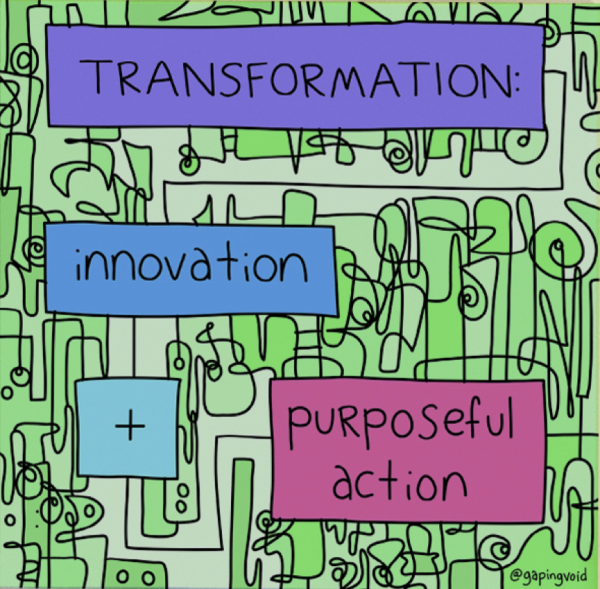
    Transformation Equals Innovation Plus Purposeful Action_GapingVoid


    There are a couple of important lessons to keep in mind when pursuing the unknown.

    • Forget what you know – self-reported "experts" are limited by their world view. If you're trying to get a different result, you won't do it by playing by the same rules your predecessors followed.  Heuristics are great for making life easier – but they're very limiting when trying to create something new. 
    • Attack the hardest problems first – your biggest problems are your biggest opportunities. If you don't deal with the big problems now, you'll never get around to it, and you'll waste time, energy, and potentially realize you have to pivot much too late.  
    • Be comfortable being uncomfortable – Most people find failure taboo, and they're deathly afraid of it. Tony Robbins talks about our tendency to avoid pain more actively than we pursue pleasure, and it's true in business. But failure is a part of business. The people I consider most successful got there through incredible pain tolerance and increasingly intense problems that they continued to conquer. 
    • Have a short memory for pain - Focus on the gain, not the pain. People often focus on not enough money, not enough time, not enough. That scarcity mindset is dangerous and can lead to getting lost in pain and fear. Learning to acknowledge the pain/fear and move forward from a place of abundance and opportunity helps create opportunities. 

    As well, a clear identity is important. You have to understand what you're pursuing, and how you want to attack the problem. At Capitalogix, we've gotten very in tune with our goals. 

    We invent techniques that identify and adapt to what happens in markets. We apply the lessons learned from past experiences, data science breakthroughs, and hard work to eliminate the fear, greed, and discretionary mistakes that are the downfall of most traders and decision-makers.

    Small businesses don't have a monopoly on these mindsets and these opportunities, but companies like Y Combinator, X, or HeroX are few and far between. 

    Those businesses that have the scale and these approaches are great to model, and there's enough innovation out there for both of you. 

    So what's your moonshot?

  • Here Are Some Links For Your Weekly Reading – June 30th, 2019

    Most people don't spend money on freemium games. These games rely on a small subset of "whales" to survive – players that spend absurd amounts of money on their games. Gacha games let players pay to "roll the dice" to unlock rare characters and collectibles similar to a "Loot Box" mechanic. 

    Now, the US is trying to make this mechanic illegal for taking advantage of children with their "pay-to-win" mechanics. 

    226827


    Here are some of the posts that caught my eye recently. Hope you find something interesting.


    Lighter Links:


    Trading Links:

  • Insights From CogX – On AI and Emerging Technologies

    Cogxlogo-600x400While I was at Camp Kotok, my son found CogX, an AI and emerging technologies conference held in London. They had speakers from academia, governments, and industry to give a more holistic view of AI and emerging technologies. 

    They put all their keynotes online, for free.

    He watched a few and sent me his feedback. Here are a couple of his key takeaways, but I encourage you to watch yourself and make your own.

    Experts and neophytes alike are making a lot of common mistakes

    We recently shared a video on this topic. Myopia is a big issue even with experts. People get distracted by the sea of opportunities and forget to focus on one. 

    As well, culturally, we get caught up in exciting long-term applications, like self-driving cars, instead of capitalizing on low-hanging fruit. 

    "Don't confuse a clear vision for a short time horizon"

    The key to moving AI to the next level is putting power in the hands of the many 

    The Googles and the Facebooks of the world are accomplishing a lot – and tackling real problems, but their efficiency is next to nil. 

    There are also a lot of niche or esoteric problems that they'll likely never attempt. Small businesses have the ability to be much more creative, agile, and risky. 

    Small business powers economies, and it also powers AI.  That being said, smaller companies can learn a lot from the current digital leaders. For example, learning to apply basic AI, instead of complex applications half-finished sitting on a shelf, or, by using AI on supporting aspects of their business instead of jumping straight to overhauling their core business. 

    We're still very early on in AI's lifecycle

    The secret to better AI is in better analysis of better data. The applications are secondary. 

    Many people are focused to heavily on the vision, without taking into account the steps to get there. Infrastructure and other foundational aspects need to be in place. 

    We need to scale investment in projects and the information available in industries. 

    Today's big force functions are Data and Talent. We still haven't ironed out the interaction between humans and AI. As we make that easier, you'll see average people being able to create wonderful things with AI – instead of creation being limited to PhDs. 

    Eric Daimler, during a roundtable on AI Capital, referenced Jevon's Paradox – the idea that increasing fuel efficiency doesn't decrease fuel consumption, it increases it. He equates this to the current bottlenecks in AI, and where AI will end up. People didn't predict the car, they didn't predict the app store, and they can't predict what the future of AI will look like. 

    What Does The Future of AI Look Like? 

    Charles-Edouard Bouée, of Roland Berger, sees a mass evolution of AI coming – with AI being anywhere and everywhere. 

    China currently has an advantage due to their size, policies, and willingness to leapfrog technologies. As competition increases, future leaders will leverage 6 points:

    • Data Availability and Usage – how much data is your country/company tracking?
    • Mathematical capabilities – AI is the new name for mathematics
    • Investment Power – are companies putting their money where their mouth is?
    • Applied Mathematics & Physics – the emphasis is on applied
    • Non-Conventional Thinking – are your applications/approaches novel?
    • Company Adoption – For countries, are you seeing adoption by the public as well?

    The top-tier companies were created in technological waves. During the industrial revolution, leaders were in commodities – Steel, Oil, Railroad. Intel, Cisco, and more were built on the personal computer, the internet, and mobile phones. Apple, Google, and Amazon were built on digital and smartphones. 

    The next wave is going to be built on AI. It's going to be built on AI becoming ubiquitous and commoditized. AI is at its most powerful when it becomes human-centric, not just problem centric.  The transition is in human/AI connection and on building platforms that enable mass-interaction with AI. Once we've accomplished that, we'll see another explosion in AI.

    Think about our infatuation with the Internet-Of-Things. As a people, we've become much more experience-centric than product-centric.  You've also seen it in VR/AR – and especially with millennials.

    What are your thoughts?

  • Camp Kotok: Economists In Nature

    I was just in Maine at Camp Kotok, a private gathering of economists, fund managers, and other financial industry professionals. 


    65308678_10156444158288321_8855162136926617600_n


    There was no cell phone service … so people had to talk with each other.  Everyone went outside.  And, people continued to fish, even when it rained.  Craziness.

    At last year's Camp Kotok, I did this interview with Bob Eisenbeis,  Cumberland Advisors' Vice Chairman & Chief Monetary Economist.  Check it out. 


    Cumberland Advisors via YouTube

    AI is removing the fear, greed, and discretionary mistakes from financial decision making. We’re at the beginning of a cycle of progress that is hard to imagine … and easy to underestimate.

    Ultimately, I think AI will transform the planet much like electricity did.  What about you?

    Lots of cool discussions up there. Call me if you want to talk about it. 

  • Committing To A Bigger Future

    I'm a big fan of picking a Big Hairy Audacious Goal (sometimes called a "BHAG") and taking actions that move you in that direction. 

    I'm also a big fan of Strategic Coach's Bigger Future exercise.  It is a 20-year planning exercise where you plan out your commitments and goals to yourself, your family, your career, and your legacy. 

    While doing this, I realized that my ideal next 20 years involves taking Capitalogix to the next level (and beyond). 

    As a result, I recently held a two-hour town hall session with everybody in Capitalogix.  You'll find a 5-minute compilation of highlights at the end of this article. 

    Before I share with you, I want to take time to bring you up to speed on Capitalogix's history. Some may know the story, but many of you are new.  It's important context for the video and for Capitalogix's future. 

    A Brief History of Capitalogix

    Times and conditions change so rapidly that we must keep our aim constantly focused on the future. – Walt Disney

    In the 90's, I left a corporate securities law practice to start a company that was an early pioneer in automation, intelligent agents, and rule-based processing.(it is almost embarrassing to compare that to AI today).  Nonetheless, we ended up on the Inc. 500 list, won lots of awards and had a great time.  Little did I know how important that would be to what we are doing now.

    Life intervened … and 1999 was a rough year for me.  My dad died of cancer, I got divorced, and I sold my company. That year inspired my TED Talk on the Time Value of A Life Worth Living, and has inspired the past 20 years of my life. 

    I threw myself into trading. At first, I was a fundamental trader.  But I quickly threw myself into Elliott Wave theory, technical analysis, quantitative analysis, and everything else I could get my hands on. I spent hours on end marking up charts and creating early algorithmic trading systems – predecessors to how we trade today. 

    I also hired my first two employees – Gabriel and Sean. My dining room became their office. I started to view trading as a business, rather than a hobby. The thought forms that would become our framework for understanding markets were starting to gel. 


    IMG_0395


    By 2015, we had 20+ employees working out of my house, and I realized we'd outgrown my home. Here is a picture from the dining room before the move.


    IMG_0283


    After a brief time with employees in three different offices (including one of our partner's offices) we found our current office. 

    Moving in to our new office represented a positive shift in culture and focus – and another step toward our goals. 


    Where We Are Today

    The power for creating a better future is contained in the present moment: You create a good future by creating a good present. – Eckhart Tolle

    We are committed to revolutionizing decision science (making better decisions faster). We're creating the future we've envisioned.

    Yet, for all we've accomplished, we're driven every day to be better than we were yesterday. That drive comes from that big hairy audacious goal and that 20-year vision.

    It comes from knowing who we want to be tomorrow. 


    Screen Shot 2019-06-14 at 4.10.28 PM


    Committing To The Future


    It means that we're going to have to have new people and new ways of doing things because the recipe for getting here isn't the recipe for getting there. As much as I respect and love you for "here." I respect and love you enough to hold you accountable for "there." – Howard Getson


    It hasn't always been easy – but building Capitalogix has been an intensely rewarding passion.

    Over the next 20 years, there are a ton of people I want to impact and a lot of goals I want to accomplish. Capitalogix is the way I intend to do that.

    I look forward to you all being a part of it as well. 

    Onwards!