We just got back from Portland, where we were visiting my oldest son — and meeting my newborn grandson.
It was a great trip. Nothing monumental happened, but years from now, we’ll continue to look back on it fondly.
I got to hold my grandson for the first time. I got to play with my granddaughter. And I got to remember how much work play takes when you are doing it intentionally. Lifting her up, bouncing her on my leg, jumping, reading, getting down on the floor to see the world from her height. Let’s just say, my body is reminding me of how much fun we had. But it was worth it.
That alone would’ve been enough. But trips like this tend to stir up more than just memories — they stir perspective.
What Once Was …
It reminded me of my grandfather.

His body was wrecked by years of professional wrestling as the Green Hornet. By the time I knew him, “playing” looked different. He’d lie on the couch, and I’d climb on top of him. He called it “playing on the second floor.”
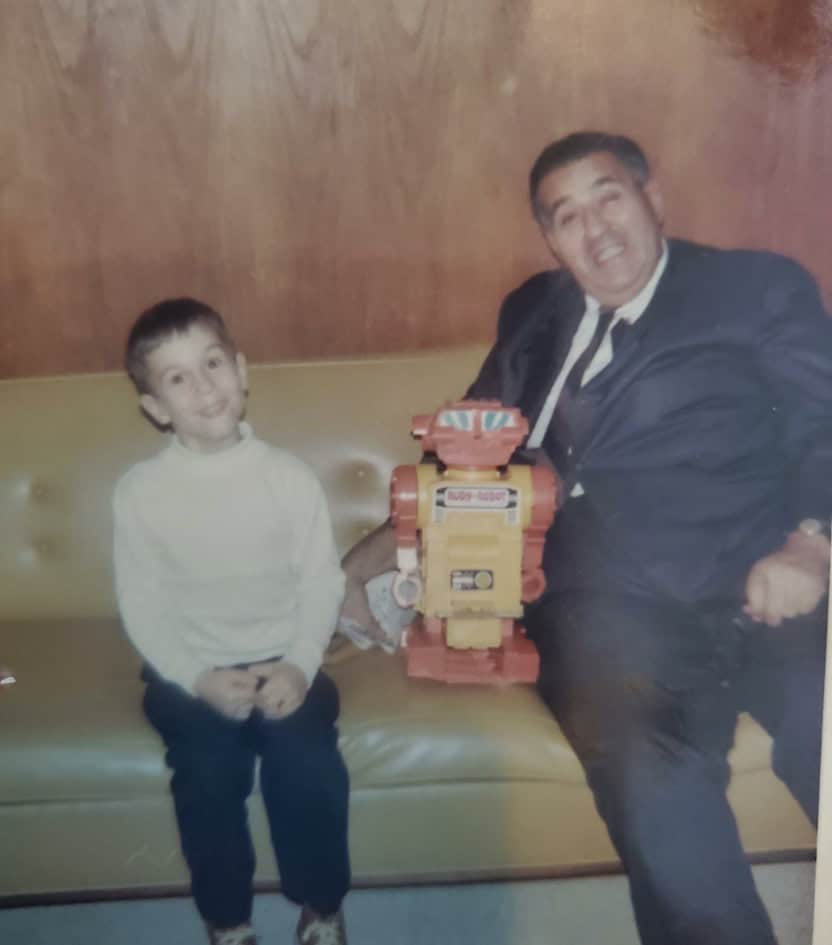
At the time, to me, it just felt like fun. Looking back, it was an adaptation. It was love, finding a way.
And then there’s the harder realization: by my age, my grandpa was already dead, and my dad was already gone because of a cancer that would be caught much earlier and treated today.
So, yeah, feeling sore after playing with my granddaughter hits a little differently. It’s a reminder that I still get to show up and participate … that I still have time. That’s not something to take for granted
It reminds me of Ray Kurzweil’s “Longevity Escape Velocity,” which is the idea that medical and biotechnological progress will reach a point where, each year, remaining life expectancy increases by more than one year, so you are effectively “outrunning” aging over time.
… but try not to die before that happens.
Don’t Touch That Dial …
In part, that’s why this visit also had me thinking about technology.
Who’s surprised?
We were talking about air conditioning — how recent it really is in the grand scheme of things, and how quickly it’s become something we can’t imagine living without. Take it away, and most of us would struggle immediately.
Or think about this: my great-grandmother was born before cars or planes existed.
Or that widespread access to electricity in cities started to roll out in the 1920s.
Think about how technologies like these have reshaped where and how people live. Entire regions went from inhospitable to must-see travel destinations.
And then I think about my own timeline.
I was born before hand-held calculators were invented or color TVs were standard.
My kids? They were born before Wi-Fi, before smartphones, before MP3s. They remember floppy disks, dial-up modems, and landlines. They remember printing directions or following someone who inevitably sped through a yellow light, leaving you guessing at the next turn.
Some things haven’t changed, though. Human nature stays frustratingly the same. My father yelling at early robo-receptionists in the 1990s feels surprisingly modern.
Through all of it, I’ve always taken a certain pride in being able to keep up. I may not set up my own tech anymore, but I still understand it well enough to be dangerous. My team sees it in the way I think through problems and, even more so, in the types of prompts I write.
I enjoy working with AI. It gives me energy and hope.
But this weekend was a reminder: there’s always another level.
The More Things Change, The More They Stay The Same
My youngest son works with me. My oldest son works in an AI-adjacent space. He is deeply technical, has the kind of mind that builds the systems the rest of us use, and he’s helped improve things you’d definitely recognize. For what it is worth, though, it has always surprised me how differently he and I use technology.
We started talking about LLMs. I told him how impressed I was with the pace of progress and how much better it is than I imagined it could be in so little time.
We talked about how the fear of missing out is so prevalent today because everyone knows somebody using AI for something they hadn’t thought of or doing something they wish they could.
As our conversation progressed, I told him that a year and a half ago, I was focused on learning how to prompt better, but now I believe it’s more important to tell AI what you want and ask it to help figure out how to get it.
As any good son would, he explained it with just a hint of … let’s call it “constructive skepticism” about my approach. He criticized what I was doing as still telling the AI too much and putting too many of my constraints on its ability to do things. He explained that the next generation of agentic swarms is designed to bypass those limitations.
He then gave me a little demo, and I had FOMO again.
And that’s kind of the point.
No matter how much you think you understand something or how proud you are about what you can do, there’s always more.
I almost want to describe the demo in detail and explain some of the business ideas it gave me. But the point isn’t about the technology; it’s about change (and what we make of that).
The pace of change right now is staggering. These tools aren’t just improving year over year — they’re improving constantly.
And that compresses everything.
Learning curves. Advantage windows. Expectations.
It also makes perspective more valuable, not less.
Because when you zoom out far enough (from wrestling grandfathers to newborn grandsons, from no cars to self-driving ones, from no air conditioning to climate-controlled everything) you start to see the pattern.
We adapt.
We build.
We take things for granted.
And if we’re lucky, we get the chance to notice it while it’s happening.
This weekend, I did … And it felt like a gift.
Onwards!
Leave a Reply