
Studying long‑term population trends shows not just how we grew from small tribes to global megacities, but where capital, innovation, and geopolitical power are likely to concentrate next.
From ancient civilizations to modern metropolises, population dynamics have influenced everything from economic prosperity to social structures.
A Window Into Our Past Gives Us a Glimpse at Our Future.
By studying this critical aspect of human history, we can gain valuable insights into the past, present, and future of societies.
Population growth is a complex, multifaceted phenomenon with far‑reaching implications. It reveals the demographic forces that have shaped our world — and continue to influence where we’re headed.
Historically, human populations grew steadily but relatively slowly until that changed dramatically.
Scientists estimate that humans have existed for at least 130,000 years. However, it took until 1804 for our population to reach 1 billion. We doubled that population by 1927 (123 years later), and then doubled it again only 47 years later (in 1974).
Early population growth was largely driven by the agricultural revolution. Since the Industrial Revolution (in 1804), advances in health and safety, and new technologies have significantly improved the quality of life, spurring rapid population growth.
For investors, operators, and policymakers, demographic data is not trivia. It is one of the few datasets that let us reliably look decades into the future — and it shapes where markets, labor, and infrastructure demand will emerge.
Here is a quick overview of key factors to consider.
Demographics: A Glimpse of the Future
It’s hard to predict some things accurately. Accordingly, one goal in data science is to figure out what we can “know” to “guess” less.
Population growth is a prime example. One of the easiest ways to predict how many 60-year-olds there will be in 40 years is to look at how many 20-year-olds there are today. Obviously, the number won’t be exact, but it’s a pretty good head start.
Likewise, demographic forecasts are powerful but not omniscient; wars, pandemics, and climate shocks can redraw maps. The point isn’t precision, but probabilities—and they still overwhelmingly favor certain regions and city types.”
This principle of using known data to make educated predictions applies to many aspects of future planning, including urban development and resource allocation. By leveraging current demographic information, we can better prepare for the challenges and opportunities that will likely impact the cities of tomorrow.
- Economic Implications: A growing population can expand the workforce, fueling economic growth. However, it can also strain resources, requiring increased investment in infrastructure, education, and healthcare.
- Social and Environmental Pressures: Demographic shifts, such as aging populations or youth bulges, can profoundly affect social structures, healthcare systems, and the environment.
- Technological Acceleration: Dense urban populations can accelerate innovation, data creation, and the adoption of new technologies.
These demographic patterns are not abstract — they have concrete consequences for economies, societies, and the environment.
Why It Matters
Population growth is more than just a numerical metric. It is a fundamental lens through which we can analyze:
- Historical Development: By understanding past population trends, we can better appreciate the factors that have shaped human civilizations.
- Future Planning: Governments, businesses, and organizations can use population data to inform decisions on resource allocation, infrastructure development, and social policies.
Have World Population Growth Numbers Peaked?
World population growth rates peaked in the late 1960s and have declined sharply over the past four decades, but we’re still on an upward trend. We’re expected to reach 9 billion people by 2050, but much of that growth comes from developing countries – and it’s almost exclusively from urban areas.
Axios created an interactive graphic that shows how birth rates and population structures vary across countries.
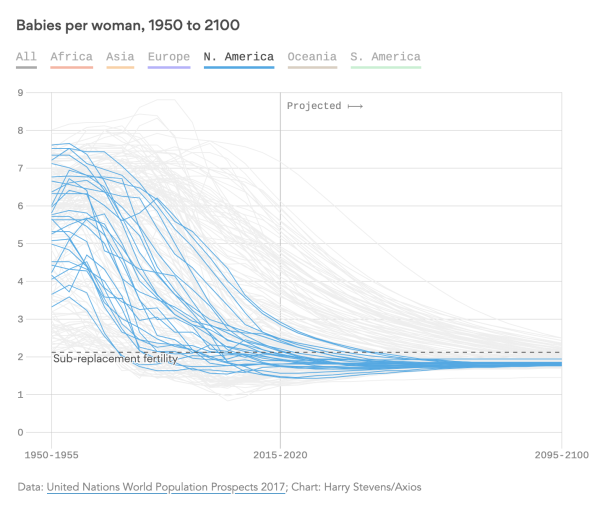
via Axios (Click for an Interactive Graph)
There are more people alive today than at any point in history — and the population is still growing, just more unevenly. Much of the future population growth will not occur in remote villages, but in dense urban centers. That shift is already reshaping the map of the world’s largest cities.
Urbanization: Megacities
For more than a century, humanity has been quietly reorganizing itself from villages into vast, dense cities. For example, in the 1800’s, only about 10% of the population lived in urban areas. Since 2014, over 50% of the world’s population has lived in urban areas – today it’s approximately 55%. That number is growing.
Ironically, as we grow more digitally connected, our world is shrinking, and our populations are concentrating.
What Megacities Change: Power, Capital, and Talent
An interesting consequence of this rapid urbanization and population growth in developing countries has been the increased development of Megacities – defined as cities with populations greater than 10 million.
Today, there are 33 megacities – more than triple the number in the 1990s. They will increasingly anchor a disproportionate share of the world’s talent, capital, and innovation.
This creates a set of interesting opportunities and challenges.
For example, how will these cities deal with infrastructure – sanitation, transportation, etc?
Visual Capitalist’s graphic below ranks the world’s 50 largest cities from 1975 to 2050.
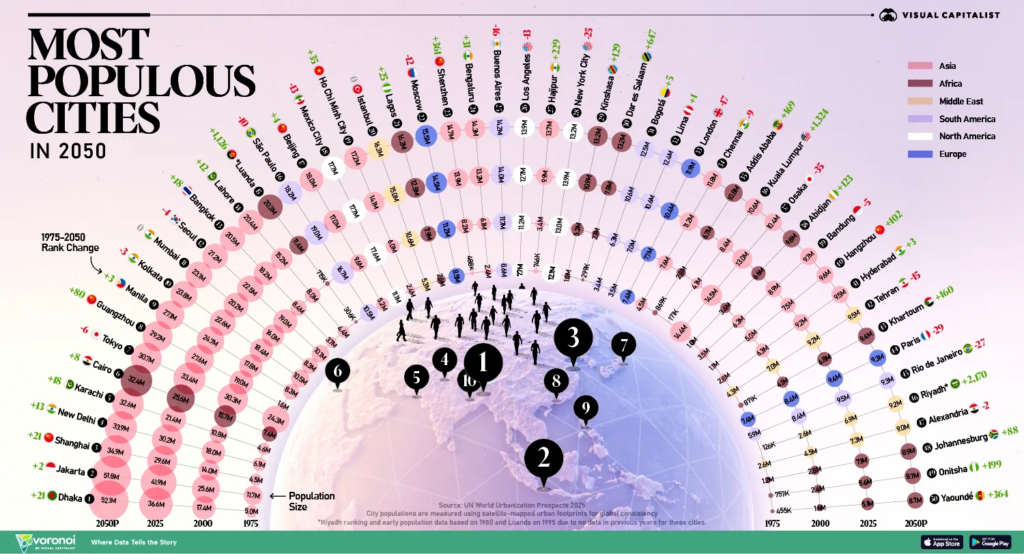
via visualcapitalist
Today, in most high-income countries, about 80% of the population lives in urban areas, in contrast to the predominantly rural populations of lower-income countries.
As a result, we see many of these megacities forming in developing countries.
At the same time, many high‑income countries face aging or even shrinking populations. That divergence — young, rapidly growing cities in emerging markets versus older, slower‑growing cities in developed markets — will shape everything from capital flows to immigration policy.
Tokyo and New York helped define the last century of urbanization. Dhaka, Lagos, and Jakarta may define the next.
Looking ahead to 2050, Dhaka is expected to become the world’s most populous city, with more than 52 million inhabitants, just ahead of Jakarta. Meanwhile, Africa emerges as the world’s fastest-growing urban region, accounting for 13 of the 50 largest cities.
As a side note, we’re also seeing countries like China making substantial investments and alliances in these developing areas. This is likely done to profit from the expected growth and also to shift the future balance of power in their favor. Sometimes it makes sense to focus on the marathon rather than just the sprint.
Demographics Meets AI
As the world becomes more digitally decentralized and globally connected, our physical lives are concentrating into a relatively small number of megacities. Understanding where those cities are, and how they grow, is one of the most reliable ways to anticipate where opportunity — and risk — will cluster next.
Over the next few decades, two forces will shape the playing field more than any others: where people live (demographics) and how they work (AI). As cities like Dhaka and Jakarta become powerhouses, it will force to rethink which places sit at the center of the global map.
Over the next few decades, a handful of megacities will punch far above their weight in shaping markets, culture, and geopolitics. Not every megacity will thrive; governance quality, adaptability, and technology adoption will separate winners from cautionary tales.
If most of the world’s growth concentrates in perhaps 50 megacities, what does a well‑positioned portfolio, business, or career look like — and how far is it from where you are today?
Leave a Reply