
To some, new technology is a good thing. To others, less is more. It’s been interesting watching many of my formerly tech-savvy peers shy away from AI.
But it’s a tale as old as time.
Most people simply “tolerate” technology transitions; some people drive them, and others crave them and use them as a catalyst for growth or strategic advantage.
Everett Rogers published Diffusion of Innovations in 1962, studying how Iowa farmers took up hybrid seed corn. He found five groups, in stable proportions: Innovators (2.5%), Early Adopters (13.5%), the Early Majority (34%), the Late Majority (34%), and Laggards (16%).
Thirty years later, Geoffrey Moore added the part that actually hurts. In Crossing the Chasm, he argued there’s a gap between the early adopters and the early majority — and that most technologies die in it. Not because they don’t work. Because the people on the far side want something the enthusiasts never needed: proof, references, and someone else to go first.
Seed corn in 1962. Personal computers in 1985. The web in 1997. Smartphones in 2009. AI right now.
The description begins with resistance and progresses towards compulsion. Reversing this sequence allows us to illustrate the innovation adoption process.
Here is a visualization of the innovation adoption model and market share.
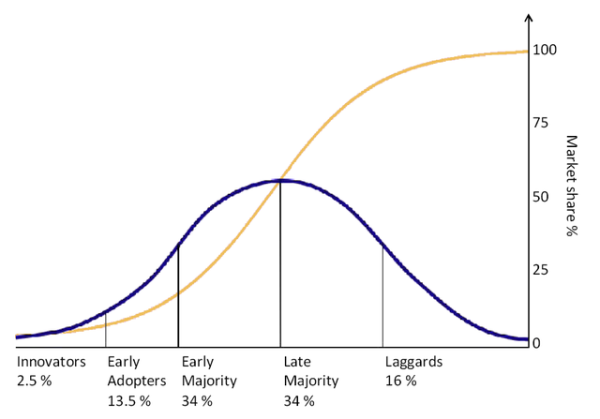
In the image above, the blue line represents consumer adoption, while the yellow line represents market share.
As you can see, only 2.5% of the population drives innovation (or adopts it early enough to help drive the Alpha & Beta versions of emerging technologies). 13.5% make up the Early adopters, who help get it ready for the mainstream. Then, the early and late majorities are the groups that ultimately consume (or use) the mature product. Meanwhile, Laggards are often forced, kicking and screaming, into “new” technologies as the early adopters are well on their way to subsequent iterations.
Here is a link to Perplexity’s description of Crossing the Chasm’s innovation-adoption model and other key concepts from the book.
Sixty years of data, and the proportions barely move. That’s the finding. The curve isn’t really about technology at all — it’s a snapshot of how people handle uncertainty, and it happens to get re-photographed every time something new shows up.
Times Are Changing …
Here’s where the analogy breaks, though — and it’s worth saying plainly. Every prior transition gave the late majority time. You could ignore the web for four years and catch up in one. The compounding was slow enough to forgive a late start. That’s the part I’m not sure survives this time, and it’s why the peers I opened with are on my mind.
Even if you are not an innovator, here are a few Innovator Mindsets that I find useful.
- You Believe There’s A Better Way
- Wherever you are, you know that there is a best next step, and you are eager to find it and take it.
- You recognize that the opportunity for more (or better) often lies just beyond the constraints or problems of the current way.
- The bigger the future, the more your efforts fuel it. When initial excitement fades, understanding what the bigger future can bring helps you power through.
- You Are Comfortable Being Uncomfortable
- You understand that Pioneers sometimes take arrows in the back.
- When creating a new reality, you expect some resistance as a result of the law of averages. Escaping the status quo takes a lot of momentum, but it’s worth it.
- You recognize when victory is near. In a quirk of human nature, too many people quit just before they would have won. Don’t make that mistake.
- You Know Where You’re Going, Even If You Are Not Sure How You’re Going To Get There
- Your goal should be your North Star. A clear direction is essential to ensure that activity leads to progress.
- Measure progress and momentum rather than the distance from your goal.
- It is easier to course-correct while in motion.
- If you’re too committed to a path that isn’t leading in the right direction, you might find what Blockbuster, RadioShack, and Kodak found.
- You Are Married To Questions (Not Necessarily Answers)
- Everything works until it doesn’t; and nothing works forever.
- It’s easy to find an answer (and think it’s correct), but there’s always a best next step or a better way.
- Figure out what you want and how to get it. This is much more empowering than focusing on what you don’t want … or why you can’t get it.
- Ask questions that focus on opportunities or possibilities rather than challenges … or what you want to avoid.
- Energy flows where focus goes.
- Commit to finding a way!
Learning From My Own Lessons
I’ve spent the last month building an AI operating system for my own work, and mindset #4 has been the expensive one.
I had a component that kept failing silently. I diagnosed it, fixed it, and watched it fail again. Then I did that four more times — each pass more sophisticated than the last, each one confidently addressing a different theory. Good analysis. Careful documentation. All of it wrong.
The thing that finally cracked it took about two minutes and cost nothing. It had been available the entire time.
What kept me from running it wasn’t laziness — it was that analysis feels like progress and a two-minute test doesn’t. I was married to a very well-argued answer. It took a month to get married to the question instead.
Being uncomfortable isn’t the price of admission to this stuff. It’s most of the job.
The 2.5% number is real, but it isn’t a verdict. It describes what a population does, not what you have to do.
The peers I opened with aren’t less capable than they were in 1999. But they have more to lose, and their horizon has changed. It make sense, but it’s also how you end up left behind.
Leave a Reply